Architecting Production-Ready RAG AI Agents for Enterprise Knowledge Bases
Moving beyond basic OpenAI demos to build secure, hallucination-resistant Retrieval-Augmented Generation workflows.


KEY ARCHITECTURAL TAKEAWAYS
- Naive vector search fails in 30% of enterprise queries without hybrid keyword (BM25) re-ranking.
- Chunking strategies must respect document semantic hierarchy rather than arbitrary character splits.
- Role-Based Access Control (RBAC) must be enforced at the vector query filter level, not post-generation.
- Semantic caching reduces LLM token expenses by up to 55% while dropping query latency from 2.5s to 80ms.
Why Naive Vector Search Breaks Down in Production
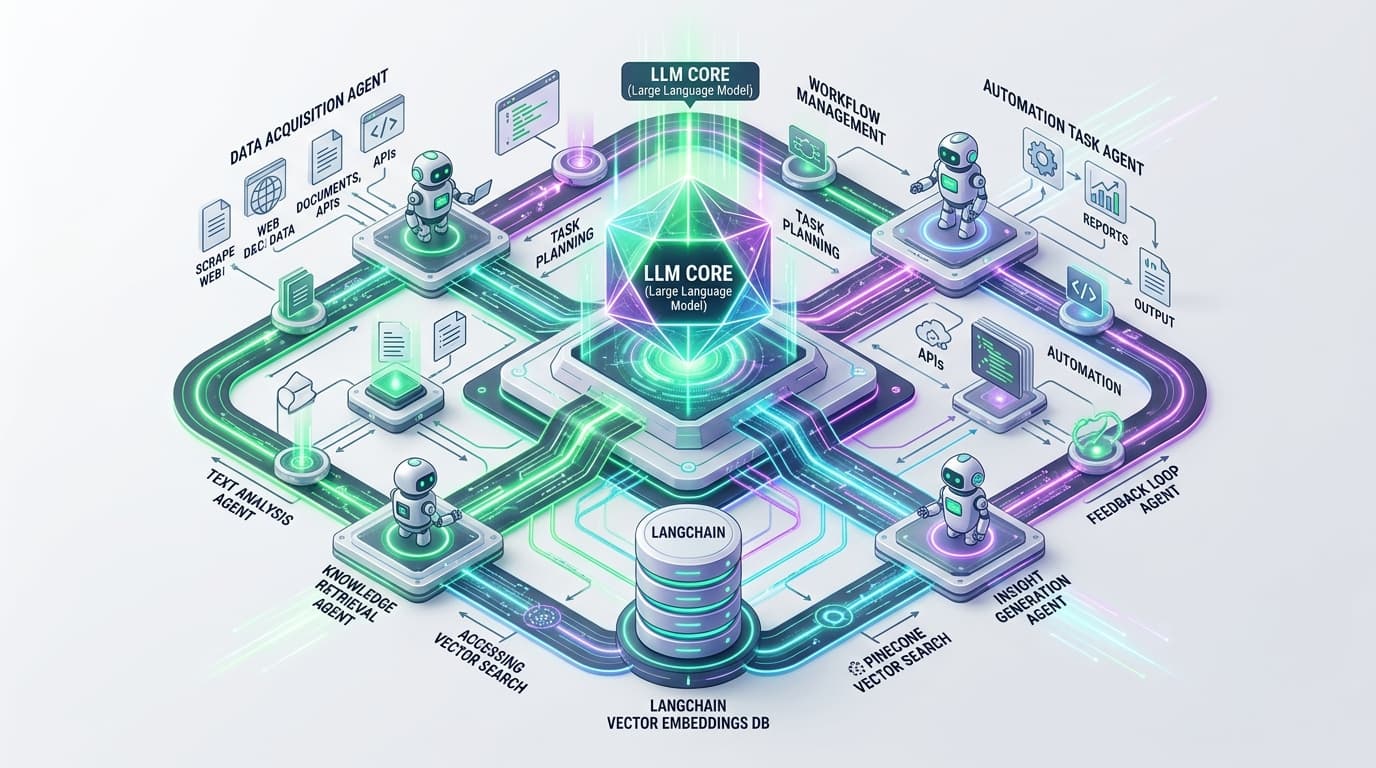
Building a proof-of-concept RAG pipeline with LangChain takes an afternoon. However, taking it to production with 500,000 corporate documents reveals glaring edge cases. Pure cosine similarity on dense embeddings frequently misses exact acronyms, serial numbers, and legal clause references.
To achieve 98%+ retrieval precision, modern enterprise RAG architectures combine dense vector embeddings with sparse lexical search (BM25) through a reciprocal rank fusion (RRF) pipeline, followed by a cross-encoder re-ranking pass.
Hierarchical Document Chunking & Metadata Enrichment
Fixed-size chunking (e.g. 500 tokens with 50-token overlap) often severs tabular data and context references. By parsing PDFs into structured AST nodes (headers, tables, paragraphs) and injecting parent section metadata into each chunk vector, the language model receives coherent context every time.
# Hybrid retrieval with metadata access control filter
results = vector_store.similarity_search_with_score(
    query=user_prompt,
    k=10,
    filter={
        "department": {"$in": user_permissions.allowed_departments},
        "classification": {"$lte": user_permissions.max_security_level}
    }
)
# Re-rank retrieved chunks with Cohere/BGE cross-encoder
reranked_chunks = cross_encoder.rerank(query=user_prompt, docs=results, top_n=3)Governance, Auditability, and Cost Optimization
Every enterprise AI deployment must implement strict data leakage guardrails. By introducing semantic vector caching (such as GPTCache or Redis Vector) for repetitive inquiries, we commonly achieve a 50% reduction in API token costs while delivering instantaneous responses to end-users.
Chirayu
Chirayu leads Infyle's AI research and cloud infrastructure practice, specializing in scalable LLM agents and vector search systems.
Need Help Implementing This in Your Business?
Our principal architects and engineers are available for strategic consultation, architecture reviews, and full-stack software development.